November 30, 2004
Wow II
By Bob
I don't know what to say about this:
An extra $5.6 billion must be spent on New York City schoolchildren every year to give them the opportunity for a sound, basic education, which they are guaranteed under the state constitution, a court-appointed panel has found.Beyond that, $9.2 billion worth of new classrooms, laboratories, libraries and other facilities must be built and maintained to relieve overcrowding, reduce class sizes and provide the city's 1.1 million schoolchildren with an adequate place to learn, the panel said.
But how much of that should come from the state or from the city itself the panel did not say, leaving unanswered one of the most daunting and contentious questions facing the lawmakers responsible for coming up with the money.
"Now we needed to roll up our sleeves and make sure the Legislature enacts this reform so that the children can get what they need," said Michael A. Rebell, executive director of the Campaign for Fiscal Equity, the plaintiffs in the case.
O.K., a few thoughts come to mind. This is a direct assualt upon our democracy when judges can make such decisions. Nothing shows more how a certain segment of this country will use any means necessary to achieve their agenda. Unable to win elections, they simply find sympathetic judges to do their bidding.
I'll post the whole article in the extension.
Update: This post at Redstate.org suggests the recent vote against stripping racist language from the state constitution in Alabama may have do with an add on giving a right to an education. I originally cringed when I read about the vote, but if it is to stop the above nonsense then I don't blame them.
Update II: Here is a New York Sun article from a few months ago talking about this. It gives current spending as $11,122 per pupil. The district has more 1.1 million students.
An extra $5.6 billion must be spent on New York City schoolchildren every year to give them the opportunity for a sound, basic education, which they are guaranteed under the state constitution, a court-appointed panel has found.
Beyond that, $9.2 billion worth of new classrooms, laboratories, libraries and other facilities must be built and maintained to relieve overcrowding, reduce class sizes and provide the city's 1.1 million schoolchildren with an adequate place to learn, the panel said.
But how much of that should come from the state or from the city itself the panel did not say, leaving unanswered one of the most daunting and contentious questions facing the lawmakers responsible for coming up with the money.
"Now we needed to roll up our sleeves and make sure the Legislature enacts this reform so that the children can get what they need," said Michael A. Rebell, executive director of the Campaign for Fiscal Equity, the plaintiffs in the case.
The report marks a major turning point in a case that educators, advocates and politicians are counting on to transform the city's schools. Nearly every state has battled over school spending in court, but the case in New York is one of the biggest - both in terms of dollars and the number of children involved - and most closely watched school financing lawsuits in the nation.
Four months have passed since lawmakers in Albany missed the deadline imposed by the Court of Appeals, the state's highest court, to begin fixing the "systemic failure" it found in the city's schools. And while the courts have refrained from holding legislators in contempt for failing to act, the report is a significant step toward a court takeover of what has traditionally been a legislative role: deciding exactly how much money should be spent on schools.
Throughout the 11 years that the case has wended through the state's courts, judges have taken pains not to step in and dictate exactly how much extra money should be spent on the city's schoolchildren. But the Legislature essentially forfeited that prerogative by its own inaction, the panel said.
"It therefore falls, by default, to the judiciary to fashion an appropriate remedy to ensure that the sound basic education constitutional mandate is honored," wrote the panel of referees. Its members were E. Leo Milonas, a former state appellate judge and past president of the Association of the Bar of the City of New York; William C. Thompson, a former member of the New York City Council, state senator and appellate judge who is the father of the city's comptroller; and John D. Feerick, the former dean of Fordham University's School of Law who was also a president of the Association of the Bar of the City of New York.
Though it is technically a recommendation, the report is likely to carry a great deal of weight in court. Justice Leland DeGrasse, the state judge in the case who must now decide how much of the report will be turned into a legal order, created the panel for the sole purpose of helping him decide how to rule on the thorny questions it tackled. Beyond that, Justice DeGrasse handpicked some of the best-known names in local legal circles to sit on the panel, ignoring nominees from the parties.
In its report, the panel called for an aggressive timetable, suggesting that the state have no more than 90 days to come up with and enact a plan to put the extra $5.6 billion toward running the city's schools. Once that begins, it gave the state four years to reach the full amount. The panel then gave the state the same amount of time to figure out how to put $9.2 billion toward school construction and repairs, but allowed that money could be phased in over five years, instead of four.
A New Florida Theory
By Bob
Michael Stastny has a post up of the latest idea from the monorail salesman, Richard Florida. The City Journal quite ably rips apart his theory of the "creative class" with incovenient facts such as actual economic performance. Undoubtedly wanting to sell more books and perhaps gain some consulting work, he is back with another application of his "work" with the comparison of creative workers across countries in the Harvard Business Review. The U.S. lags behind other countries in this which would imply that Florida thinks we could lag in performance.
Unfortunately, actual economic performance gets in the way his theory once again. If you scroll down to the bottom of the post, Michael has put together a couple of graphs that seem to put a dent into this idea. There doesn't appear to be any correlation between the percentage of creative workers in a country and the 5 and 10 year growth rate.
There does appear to be one outlier there however, Ireland. It seemingly could provide some sort of anectdotal evidence that perhaps there could be some merit, just as say the fabulous wealth of Silicon Valley seemed to support his previous work with cities. Florida even wrote an op-ed telling Pittsburg to follow the Irish example. The big problem with this is that Ireland is a model of what countries, states and cities should be doing to spur economic growth, cutting taxes. Also, Ireland's growth was largely driven by investment from U.S. technology companies(almost half by some measures). In other words, while the Irish had an educated class of people available as a workforce, they didn't generate the ideas for new enterprises that drove the growth.
A quote from the City Journal article mentioned above sums it up nicely:
Now comes Florida with the equivalent of an eat-all-you-want-and-still-lose-weight diet. Yes, you can create needed revenue-generating jobs without having to take the unpalatable measures—shrinking government and cutting taxes—that appeal to old-economy businessmen, the kind with starched shirts and lodge pins in their lapels.
Restaurant Prices and the Minimum Wage
By Kevin
Just received notice about an interesting Chicago Fed working paper, and thought I'd pass it along."The Minimum Wage and Restaurant Prices" by Daniel Aaronson, Eric French, and James MacDonald has the following abstract:
Using both store-level and aggregated price data from the food away from home component of the Consumer Price Index survey, we show that restaurant prices rise in response to an increase in the minimum wage. These results hold up when using several different sources of variation in the data. We interpret these findings within a model of employment determination. The model implies that minimum wage hikes cause employment to fall and prices to rise if labor markets are competitive but potentially cause employment to rise and prices to fall if labor markets are monopsonistic. Therefore, our empirical results appear to provide evidence against the hypothesis that monopsony power is important for understanding the small observed employment responses to minimum wage changes.I'll reserve judgment until I can read the whole thing.
2004Q3 GDP Rises from 3.7% to 3.9%
By Kevin
Jeannine Aversa of the AP files an absolutely meaningless report:
The economy - helped out by more brisk consumer and business spending - grew at an annual rate of 3.9 percent in the third quarter, a performance that was stronger than previously thought.A revision of +0.2% is not good news, it's noise: an irrelevant and economically meaningless statistical abberation. There is, practically speaking, absolutely no difference between 3.7% and 3.9% quarterly growth at an annual rate, even if the BEA can allegedly pinpoint where it previously undercounted. In fact, there is practically speaking, no difference between 3.9% and 3.3%. GDP measurement is not that accurate!The new reading on gross domestic product, which is based on additional data, was up from the 3.7 percent growth rate first estimated for the July-to-September quarter, the Commerce Department reported Tuesday.
GDP measures the value of all goods and services produced within the United States and is considered the broadest barometer of the economy's health.
The 3.9 percent growth rate registered in the third quarter represented a pickup from the second quarter's 3.3 percent pace and marked the best showing since the opening quarter of this year.
Journalists seem to have no background in errors of economic data; so here are two rules of thumb: 1) the average change in GDP from the first to third release is about +/-0.5%, and 2) revisions after that (which are uncorrelated with the first two revisions) revise estimates an average of +/-1.0%. Anytime you see changes smaller than that, they're more likely than not to be eliminated by later revisions.
Note to The New York Times web editor, just because it sounds important, doesn't mean it should be on the front page:

November 29, 2004
Private Equity
By Bob
The Economist has a survey of private equity this week(only one of the articles is free). It raises many of the points that a friend of mine who works for one such firm has been making for a couple of years now. Here's an excerpt, but read the whole thing(my friend even gets comments comparing him to the portrail in movies):
Will tougher competition and increasingly demanding investors cause the industry to consolidate? Sir Ronald Cohen of Apax Partners thinks that over the next decade the private-equity industry will polarise. At one end, a few big global industry leaders will emerge—“maybe three or four dominant brands with high returns”; at the other, small specialist firms will thrive. In the middle, however, many firms will find it hard to compete. His prediction is plausible, and the losers may include some famous names. Forstmann Little has already said that it will close in 2006. It made some awful telecoms investments during the bubble and has failed to resolve its succession problem.
Jock Tax
By Bob
While reading through the Tax Foundation's Tax Watch newsletter, I ran across an article on the origins of athletes paying income tax in states where they play away games. As one could imagine, it now affects many beyond the star athlete.
If state tax collectors have their way, we may all be “jocks” soon.That’s the finding of a new report from the Tax Foundation that explores the growth of “jock taxes”—taxes requiring visiting athletes and other team employees to file tax returns in every state where games are played.
“The jock tax began with California trying to get back at Michael Jordan and the Chicago Bulls for beating the Lakers in 1991,” said David Hoffman, adjunct scholar with the Tax Foundation and co-author of the new report. “Illinois fought back with a retaliatory tax the next year. Since then, many other states have joined in.”
Today, of the 24 states with pro teams, 20 have enacted jock taxes, along with a half dozen cities.
The study finds that revenue-hungry state treasuries are extending their income taxes to more and more nonresidents who just work a few days a year in their states. Jock taxes were first aimed at a tiny number of wealthy athletes, but the study shows they are now beginning to spread to salespeople, newspaper reporters, lawyers and others, forcing non-jocks to pay as well.
New Jersey has begun taxing visiting attorneys, Cincinnati has levied a tax on touring skateboarders, and several jurisdictions have begun taxing traveling entertainers.
Click here to download the PDF and scroll to page 3 for the whole thing.
Gramm
By Bob
Robert Novak is reporting in his Sunday column that Phil Gramm may replace Snow at the Treasury should he depart. This can only be good news for free markets and limited government. Gramm is one of the few politicians that I don't dislike and think he would be a great addition to a White House that sometimes has strayed off the reservation. Of course, the cries of the most right-wing government in history will come up, but Gramm is a tough political fighter who may be able to best navigate through the "ownership society" agenda.
Update: Opinion Journal has more.
Government Efficiency
By Bryan
Why do I read the Ohio State University paper, The Lantern? I am constantly met with misinformation such as this article titled Taxes needed. This anonymous editorial suggests that without the additional 1% in state sales tax that is scheduled to expire next year, Ohioans will not get college education. I am going to quickly try to examine this situation, but this is another of my pet peeve issues that I would love to have time to study in detail.
This is absurd. I know that I don't need to explain the economics of tax to you, preaching to the choir and such. In this state where people continue to plead for lower unemployment, they need to realize that taxes create unemployment! Period. A sales tax specifically taxes consumer purchases from companies typically hiring lower wage employees.
However, think about money loosely in terms of Einstein's relativity, it can be neither created nor destroyed (I realize this is a loose concept.) So the supposed $1.25 billion can either be spent by the Government or saved and spent by the citizens. Approximately $200 per citizen per year. The question is not can one do without $200, the question is who can better decide how to use the $200. This is an issue of efficiency.
Many charities are rated for their efficiency. Usually it terms of how much money ends up spent on the purpose at hand and how much is spent on bureaucracy, salaries and other extraneous expenses. The Government, like any charity, should be measured in terms of efficiency.
Does anyone have a good reference for government efficiency?
A dollar spent for a dollar worth of goods is 100% efficiency. As an individual my efficiency is 100% minus the taxes I pay. Federal income tax reduces this by 30%, state income tax extracts 8%, city income tax takes 2% and sales tax brings it down another 7%. This brings an individual's efficiency to 53%. Charity donations might bring this down another 10%, now I am less than 43% efficient.
So what happens to the 57% consumed by the government and charities? A good charity will spend 75% on the actual charitable cause, so 25% of my lost 10% is a total of 2.5% of an individual's total efficiency lost to a charity, but an individual regains 7.5%. Now the total of an individual's efficiency is about 50.5%. The only remaining question is how much of the government budget is spent efficiently and how much is wasted on salaries and other bureaucracy. I doubt the government can beat 75% efficiency. Let's give them the benefit of the doubt and assume the Government is 50% efficient. Therefore 50% of the Government's 47% is a total of 23.5% loss. Individual (100%) - Charity (2.5%) - Taxes (23.5%) = 74% total efficiency. This is probably the most generous measure I could make since it fails to account for capital gains and lots of other factors. However it is easy to see the difference between losing 2.5% of my income by allowing a charity to spend my money and losing 23.5% of my income by allowing the Government to spend my money.
The fundamental economic assumption is that the best way to make economic decisions is in a market. As a market for charity & taxes, the Government extracts HUGE portions of this market through their monopoly. In the market for charity the Government has excessive market power.
Take control of your money and donate to your favorite charity.
Reduce taxes at every opportunity.
Who knows how to best spend YOUR money? You or the Government?
Daniel's Introduction
By Daniel
Much thanks to Kevin for the invitation to blog.
In brief, here's my story:
I'm finishing up my last semester as an undergraduate economics student at George Mason. Fall 2003 I started up a club here called the Order of Economics to bring together some people who liked sitting around and talking about economics (usually taking place at a pub). We're currently on a break.
Over the summer I decided to jump on the econ blog bandwagon and start my own from the advice of a friend (which has gradually fallen by the wayside--there's just too many blogs out there as it is).
The economics that I am mostly interested in and try to practice is 'Everyday Economics' which typically doesn't involve much (if any) technical machinery, as was initially spurred by Landsburg's book "The Armchair Economist (though there are many more to credit for this genre)."
I hope to hear some feedback and look forward to posting soon.
Daniel
North Korea Free Trade Zone
By Bob
Marmot's Hole has tranlated an article about North Korea's free trade zone:
The Chinese tourism bus passed over the border bridge. “I’ll have to give North Korean girls a look tonight,” said a Chinese from Shanghai by the name of Kong. The middle-aged Chinese men who made up most of the tour group looked like they were enjoying themselves. After the bus out of Yenji, China entered North Korea, it followed a rough road for about two and a half hours. Along the way, we passed haggard-looking farmers and half-dilapidated wood-board houses. Our destination was the Rajin-Sonbong Free Economic and Trade Zone’s Emperor Hotel.
There more in his post. For those of you who want non-work safe material, check out his post on Japan.
November 28, 2004
The Little Things
By Kevin
Customer service starts and ends with the little details. I prefer proper courtesy and attire, although I never expect a salesperson to remember my name and preferences. Binary Bonsai prefers to never fill out any more web form fields than absolutely necessary:
Here's why: In Denmark... we do not have 'states' or 'provinces'!Are online retail companies lazy, or are the costs greater than the benefits?So stop forcing me in to filling out it out with something as redundant as NA. It's easy, here's how you do it: If I pick Denmark or any other non-state/provincial country from the dropdown, make the state/province input field non-required.
You've got dynamic pages and everything, it's not that hard.
From the comments, we discover that regions come in many flavors: state, district, province, county, oblast, etc. And in Ireland, there are no postal codes--except for Dublin city--but most online forms require a postal code.
The big spender wins again.
By Vinayak
The Hindu, one of South India's most popular newspapers, reports that the Congress ended up spending Rs. 125,43,33,247 (or $27.9 million using exchange rate calculation) on the general election held earlier this year. This is the highest any party has ever spent (I adjusted for inflation and checked... its true) on an election campaign.
That kind of money is huge... the story goes on to list out the various cost breakups, and reading about these wastages just becomes a more disconcerting ordeal.
While few argue the almost unitary correlation between high spending and election results, I'm beginning to have my doubts on Democracy:
1. It costs too much.
2. The money comes from sources that are too few in number.
3. Refer to point 1.
4. Refer to point 3.
What worries me is that this trend is especially dangerous for a country like India, where such large amounts have far higher utility spent elsewhere. Using my own 'Big Mac' adjustment, I reckon that the money spent could well be worth $97 million dollars (A Big Mac costs about 54 rupees in India, and about $4 in the US). That is *still* one HECK of a lot of money.
You can read the original story here.
Update:
Yazad was kind enough to point out that I had got my Big Mac prices wrong. He makes the point that its not a Big Mac but a 'Maharaja Mac', and costs Rs. 54 Rupees not Rs. 20. I have corrected the values in the post. He also makes another point in his comment which I will probably write about in a seperate post. I still stick with the "one heck of a lot of money" statement though :-)
November 26, 2004
Centurion Black
By Kevin

Via Drudge, we read about Antoinette Millard, a con artist suing American Express for issuing her a Centurion Black credit card, and letting her charge $150K a year:
She says she was mentally ill at the time of her spending spree and that American Express should have known that she was acting irrationally and impulsively.The Centurion card, launched in October 1999, provides many exclusive benefits:She is suing them for $2 million.
Personal AssistanceThe Amex Centurion web pages are not easily found. But there are web forums discussing the gritty details, including the annual fee:Each cardmember will be assigned a personal travel counselor to handle all travel needs, and their own concierge to help with anything from special occasion planning and selecting ideal gifts, to locating unusual items.
Retail Privileges
Special privileges will be extended to Centurion members at Neiman Marcus and Saks Fifth Avenue, including personal shopper services, invitations to exclusive events, free consultation for restyling of precious jewelry (Neiman Marcus) and private shopping hours (Saks.)
I'm not rich, and would not use this card if I became rich. To some people this card sounds like conspicuous consumption--a tool of the ultra-wealthy; and it does demonstrate that a premium level of luxury is available only to them. But more importantly, it demonstrates that most of the services available to the ultra-wealthy--from basic financial advice to flight insurance to fraud protection--are available to anybody with any Amex card. Immense wealth still permits the expoitation of a team of fawning yes-men and personal servants. But Centurion club members cannot walk on water; aside from being treated with kid-gloves, they're just like everyone else.
Q: Ok because I am such a loyal spender with American Express will they give it to me for free?Afraid not, American Express charge different amounts depending on the country of issue; in the US the fee is $2500 and in the UK £650, although in the case of the latter you can now renew for free.
Full photo here, and card reviews here and here. From the latter, a perfect example of the real benefit of the Centurion card:
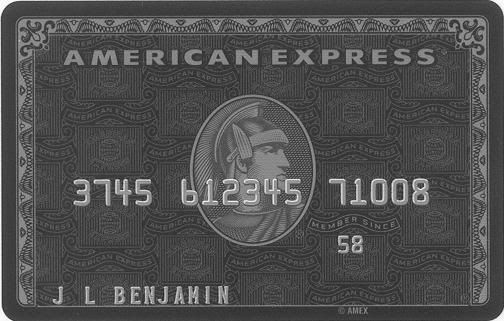
He first received the card on the day of my birthday and used it to pay for a 600+ dollar meal at Ruth Chris’ Steak House. Despite the fact that the waiters there have probably served some of the wealthiest customers in the area, the waiter my father gave the card to went around showing his friends (the other waiters). Not only that, but the manager of the restaurant came down shortly after paying the bill to see how things were and asks if my father wanted to celebrate my birthday (I guess the waiter had spoken with him) with a bottle of wine compliments of the house. I can’t see why anyone would not want to own this card if they could. Even if for nothing other than the sheer prestige that seems to come along with it.
UPDATE: At Overlawyered, Ted Frank has the details on the Amex lawsuit, as well as a link to a photo of the alleged perp.
The Ukrainian Economy
By Kevin
Many people are focusing their attention on the public resistance and uncertain revolution in Ukraine. We focus on the Ukrainian economy, which has lately been the fastest growing in Europe; after a seesaw economy in the 1990s, quasi-independence from Russia has brought a domestic investment boom and foreign investment slump. Two weeks ago, BusinessWeek had a must-read article on the entire economic affair:
But what's behind it? A combination of good luck and good macroeconomic policy. The luck is that metals, particularly steel, make up 60% of Ukraine's exports. Global prices have been high recently, thanks largely to demand from China and other Asian markets. The sound macroeconomic policy has been followed by successive governments since a financial crisis in 1998. The country has a 9.7% current account surplus, public debt is a low 24% of GDP, and inflation is in single digits. The wide-ranging privatization of the 1990s is bearing fruit: Some two-thirds of GDP is produced by the private sector, the main engine of Ukraine's growth. True, much of that is owned by a small number of tycoons. But these oligarchs -- the same term used in Russia -- are investing serious money in sectors such as agriculture, telecom, and banking. "Yes, privatization was dirty, but it has shown its effectiveness," says Olexander Paskhaver, president of the Center for Economic Development in Kiev.Should Viktor Yushchenko manage to unseat the sitting Prime Minister through judicial decision or violence, what is at risk economically?
With Ukraine's economy booming, it's not only governments but also investors who have an interest in the poll. If Yushchenko, a strongly pro-Western politician who jump-started Ukraine's boom when he was Prime Minister from 1999 to 2001, pulls off a victory, Ukraine could see major reforms that will put the country on the international investor map like never before. But if the ruling elite rigs the election to ensure a Yanukovych win, as some foreign governments fear, Ukraine faces the risk of international isolation and serious political unrest.The current PM and practically de-facto Presidential incumbent, Yanukovych, is actually an economically grey oligarch:
A former governor of the Donetsk region in eastern Ukraine, Yanukovych is linked to that area's powerful coal and steel barons. His government has openly favored the interests of these oligarchs, who are allied with Kuchma. In May it privatized Kryvorozhstal, Ukraine's largest steel producer, awarding the company to a business group headed by Kuchma's son-in-law, Viktor Pinchuk, even though the winning bid of $800 million was far less than a $1.5 billion offer from U.S. Steel Corp.Two years ago, BW was worried that former President Kuchma's authorization to sell Iraq a sophisticated--and UN sanctions-violating--aircraft detection system would upend Ukrainian economic growth. It didn't. An article from Ria Novosti argues that, from the perspective of the Russian businessman, Yanukovych will give his own oligarchs with the best deals, while Yushchenko will break apart the old Soviet supply chains, hurting both Ukrainian and Russian oligarchs. This is why, despite the protests and media defection, Ukrainian oligarchs still support Yukanovych:Still, the Yanukovych government has its share of economic achievements. It has slashed the top income-tax rate from 40% to a flat 13%, passed laws to facilitate land privatization, firmed up protection for intellectual-property rights, and pursued membership in the World Trade Organization, which is expected by 2006.
Most remain wedded to Mr Yanukovich, especially the barons of his political heartlands in the industrialised Donetsk region. But a few are beginning to wonder whether Mr Yanukovich still offers the best protection for their interests.To put the squeeze on these guys, Russia threatened to stop ALL foreign investment into Ukraine.Many are also coming under pressure from employees who are openly supporting Mr Yushchenko - putting up posters in factories and workplaces and taking time off for demonstrations.
Much will hinge on the attitudes of the country's two wealthiest men. One is Viktor Pinchuk, Mr Kuchma's son-in-law and head of a business empire that ranges from manganese to media, including the Novy Kanal, STB and ICTV television channels.
The other is Rinat Akhmetov, the chief of a steel and coal empire based in Donetsk and Mr Yanukovich's main business backer.
This would be comical if it weren't so damn serious.
Other Links:
CIA World Factbook - Ukraine
Institute for Economic Research and Policy Consulting - Historical Data 1991-2001
Ukrainian Business - Links to a number of interesting articles.
November 22, 2004
Wow
By Bob
Daniel Weintraub says he's "trying get his mind around this story". Frankly, I don't have much of one left after reading it. What they are going to do is create a leftist cocoon and then wonder why surrounding communties vote the wrong way. I suppose they won't mind much not having to come into contact with red county people. They'll call them stupid:
Hoping to get a leg up on rising home prices, Davis is climbing the economic ladder to reach the next rung of families who need help finding affordable housing: those earning nearly $100,000.The City Council has approved a plan requiring builders to make 25 percent of homes in new developments affordable for middle-income buyers, defined as families of four who earn $72,240 to $96,320 annually. The rule is on top of an existing 25 percent requirement for low-and moderate-income buyers, who earn $30,100 to $72,240 for a four-member household.
In addition, officials want folks who work in Davis to get first dibs on the affordable homes. Some who don't work, however - including retirees and those with disabilities - also would get preferences. Meanwhile, the city is studying a cap that would limit residential growth to 250 units annually.
There is also a need to keep out the undesirables:
Appearantly, only the right people are allowed:
"We're very excited about it," Mayor Ruth Asmundson said. "This council has been saying we want the people who work in Davis to be able to live in Davis to maintain the quality of life we have. They have to have a vested interest in the community."
"We're talking about folks like nurses, police officers, firefighters, teachers and administrative personnel at UC Davis," Emlen said. "Some professors even fall into that category, depending on where they're at in their tenure."
On the plus side, members of my extended family will benefit from this since they are business, property owners in one of the surrounding exurbs of Sacramento. If the city wanted make housing affordable, they would increase supply. Something that the counties to the north, and my relatives, will be happy to give people.
Edit: I should add what this means. Up to half of all new housing built in Davis will be non-market with restrictions on who may buy these units. The proponents have particular people in mind as to who could get them. What this means is that the non-controlled housing will be high-end and affordable only to the well off. This is a form of a tax and some recent studies have shown to be significant. The other housing may end up being market priced, but of lower quality and restricted on who may purchase beyond income requirements. In other words, the middle will end up being squeezed out with only high end housing and lower quality housing being built. What surprises me is how blatantly discriminatory the preference is.
A Brief Case for NASA (or, NAA, as I'd suggest)
By Ian
Via a short post at ChicagoBoyz, I saw an interesting piece by Paul Jacob at TownHall.
It's worth a read, but here's the upshot: since private industry has proven itself to be highly interested in -- as well as capable of -- space exploration, NASA should be defunded since it has proven itself outdated in both thinking and performance. The piece stops a little short of calling for full shuttering of NASA:
Maybe NASA should remain, as an umbrella or watchdog organization. Maybe not. The Office of Commercial Space Transportation seems to be doing a good job. But no matter what its ultimate size and shape and scope, NASA can and should built down [sic: I think it might be meant as "should be built down"]. Now.
I'm sympathetic, to an extent.
Now that my work brings me into regular contact with NASA, I have two arguments for keeping some form of NASA around: 1) Your tax dollars help pay a small part of my company's pool for payroll. Thank you all, by the way, and consider this your "full disclosure notice". 2) The first "A" in NASA is aeronautics, and in that field I think NASA still has some valuable room to play.
A large part of the work conducted by NASA deals with the issues that abound in a country heavily dependent on the safe functioning of its national airspace. This means the technology for tracking planes, scheduling arrivals at airports, training for the people monitoring traffic, and a whole slew of minutia that doesn't dawn on you until you sit behind a pile of papers and reports and have to sift through them.
Yes, even within this realm there are things that NASA is probably overly concerned with. For instance, I am now a serial user of a concept/term Don Boudreaux used in this post on the FDA: choosing your own level of safety. But in this it's probably best to pull apart the FAA (which deals heavily with safety regulation) and NASA, despite NASA essentially being the R&D branch of the FAA.
However, in terms of that first "A", I tend to view the work of NASA as a solution to one massive coordination game that's in the same vein as "choosing" which side of the road to drive on. That is, the technology that guides the national airspace is, from what I can tell, something that ought to be uniform across the country so as to avoid planes running into each other in the air or on the ground. Competing products for air traffic control towers might sound like a fine idea, but without a standard set of terms, mechanisms, priorities and the like, you might well run a significant risk of having two planes attempting to reach similar metering points (common points of approach to airports that traffic will be routed through so the planes can reach runways and so on) at the same time, or trying to use the same runway to land. Handoffs from one sphere of control to another as planes cross the country ought to have agreed upon methods so we don't lose flights indiscriminately. From this, however, flows a great deal of work on how best to optimize the traffic patterns for flights, capacity at airports, flight patterns and methods of flight path planning (such as the possibility of "free flight"), sorting out arrival times that heavily affect commercial industry in terms of cargo and people, just to name a few.
Little of this, you'll notice, has to do with space. As I mentioned, I'm very sympathetic to the arguments about the "S" part of NASA. Which is why my choice would be to reduce the amount of space-related work NASA does, and have it focus almost exclusively on domestic and international airspace issues. A National Aeronautics Administration, perhaps.
November 21, 2004
Does Technical Advancement Breed Disposability?
By Ian
I'll spare you all the frustrating-but-possibly-amusing-in-the-retelling story of dealing with the customer service people for my cell phone. Suffice it to say that it took several phone calls and multiple conversations each time to determine that my phone needed to be taken to the local cell phone retail location. Since it's my only phone, I promptly went to the store. Surprisingly, the line was short, the service friendly. I explained my problem, and they said they'd take a look. I went to the rack of amazingly expensive phones to indulge my techo-fetish issues. I thumbed a Pa1mOne, then turned around to ask how long the process would take. That's when they handed me my new (though identical) phone.
That was it. They threw out the other one without even checking the parts, transferred my numbers to a new phone, and washed their hands of the whole thing. Mind you, no one ever proved the problem was with the phone. When asked, the person behind the technical service counter said yes, it really was cheaper to just give me a new one than to order parts and repair the old one. Of course, it's deeper than that. Turns out, it's cheaper to give me a new phone than to even explore the possible problems with the old phone, let alone get new parts if such were required. What surprised me, though, was that it goes still deeper. Turns out that there isn't anyone at the store that knows how to even go about assessing the technical issues of the phones. The "tech department" focuses almost entirely on software issues. The physical phone is a toss away item.
If it's not worth hiring or training people to work on phones at their current state of technology, I'd expect the situation to only get "worse". That is, with the growth of cell phone/PDAs there will be more things that could go wrong, each of them more technically complex than the last, and thus there will be more reason to pitch them every time a customer comes in with a technical problem (a problem that could itself increase, since fitting more features in a relatively similar space to less sophisticated phones might require using parts ever more sensitive to shock). This, I'd guess, means that the technical advancement of phones has to keep a breakneck pace; the newest phones can command the highest prices and make up for the fact that cell service providers will end up throwing a certain percentage away.
Of course, that pace of increased sophistication (if I'm on to something) increases the amount of "slop" phones that have to be purchased by service providers and resellers like Best Buy/Circuit City/etc. Makes me wonder if there's an opportunity out there for good technicians to buy up the discarded phones, fix them, then resell them internationally where cellular networks are outpacing land-line development, but don't have the disposable income of more developed nations.
UPDATE: After less than 24 hours with the new phone, I can report...nothing's changed. As I suspected, there was nothing wrong with the phone itself. Not that I'm surprised that the service for cell phones is bad.
November 18, 2004
Is Academia Liberal?
By Bryan
The final word: Here. Thanks to the VC for pointing out this research.
The most conservative academic department? Economics at only 3 Democrats to each Republican.
Was there ever any doubt?
Sunday Shopping
By Kevin
A limited number of blue laws still prevent Americans from specific economic exchanges on Sunday--especially liquor purchases. In Virginia, the General Assembly accidentally removed exemptions from the "day of rest" blue law for 12 days this year; also, good luck trying to buy a car on Sunday, as blue laws have caused a unique coordination failure:
Come to Honda City on Saturday or Monday, Eubank said, but not on Sunday. Shop online 24 hours a day, he said. All you have to do is visit the Web site to see what's in stock. You can even figure out the value of your trade-in with the Kelley Blue Book on the Web, on a Sunday. But whatever you do, don't expect to find a salesman on the lot on that day.When I called David Reynolds at Alexandria Toyota, he assured me that you can bet on the dealership being open every Sunday from noon to 5 p.m. "It's customer service, 100 percent," he said. "They expect to be able to shop on Sunday. It can be a busy day for us."
Only a few minutes later, Pohanka Chevrolet in Chantilly was telling me that they are open only two Sundays a month -- the last two -- in an effort to satisfy both customers and employees who need a day off.
On it went: Fairfax Jeep, closed. Fairfax Honda, open.
Wikipedia has some general historical context:
The term blue law was first used by Reverend Samuel Peters in his book General History of Connecticut, which was first published in 1781, to refer to various laws first enacted by Puritan colonies in the 17th century which prohibited the selling of certain types of merchandise and retail or business activity of any kind on certain days of the week (usually Sunday). In Texas, for example, blue laws prohibited selling housewares such as pots, pans, and washing machines on Sunday until 1985; Texas car dealerships continue to operate under blue-law prohibitions. Many U.S. Southern states still prohibit selling alcohol on Sunday. Many unusual features of American culture — such as the fact that one can buy groceries, office supplies, and housewares from a drug store — are the result of blue laws, as drug stores were generally allowed to remain open on Sunday to accommodate emergency medical needs.The Columbia Encyclopedia has a similar entry, with smoother writing.. You might be glad to know that blue laws are on the decline in the US. :
"The lifting of blue laws, in their own way, seems to de-emphasize religion, as well as close family, community, and neighborhood ties," says David Laband, an economics and policy professor at Auburn University in Auburn, Ala., and author of "Blue Laws: The History, Economics and Politics of Sunday-Closing Laws." "It is part of a broader social and cultural trend toward isolation."Well, the Swiss were following us along into greater "isolation", but free-shoppers have run into opposition:To be sure, recent repeals are the consequence of state budget gaps, not a simple relaxation of the nation's moral code.... New York, Delaware, and Pennsylvania have also lifted regulations on Sunday alcohol sales [last] year, with the aim of raising tax revenues.
"The states are in their worst fiscal shape in recent history," says Frank Coleman, senior vice president of the Washington-based Distilled Spirits Council of the United States. The national trade association estimates that sales in Massachusetts could generate $1.5 million to $2.1 million in new tax revenue for the state.
Presenting its case to the media in Bern on Thursday, campaigners said allowing shops at major railway stations and airports to remain open on Sundays would neither increase sales nor bring any benefits for shop employees.Unions are concerned that people might not be paid for working on Sunday.The launch of the campaign comes less than two months after parliament came out in favour of relaxing the country’s strict Sunday trading restrictions.
Opponents have attacked the proposal, arguing that it will only serve to redistribute trade over seven days instead of six.
“Each Swiss franc can only be spent once,” said committee member and Social Democrat parliamentarian, Alain Berset.
Really.
My Take: I can't do better than commenter Nicole on this post: "i think that blue laws suck and they are dumb" Granted, reasonable people may differ.
November 15, 2004
The Internet and the Commerce Clause
By Bryan
Last week I made note of a Wahington Post article regarding VoIP and the barriers to expansion that have kept providers out of some states. You can read the original short post at My Street.
In summary, Vonage won an FCC ruling that state regulators do not have authority governing internet phone service. The FCC would like to keep the power of regulation to itself. Specifically, Michael Powell declared, "...several technical factors demonstrate that VoIP services are unquestionably interstate in nature." I have watched Michael Powell make many anti-free market decisions in the past, but I wholeheartedly support this move.
Vonage and other VoIP providers are able to provide service to the entire world by shipping product from one office. This is clearly interstate business. Improved communications, and more specifically the Internet, has enabled many companies to instantly expand a local market to a global market. Even from thousands of miles away these companies introduce competition, new services and better quality for their customers.
I can personally understand the barriers these service providers were battling. While selling security electronics to the 50 states and Canada, I found less regulation (albeit more taxes) selling to Canada than I did selling to a nearby suburb. Each of the thousands of police districts had created a unique set of regulations and each demanded various forms of registration, taxation or fingerprinting. Sending employees to be fingerprinted in 50 states is a uniquely expenisve barrier to interstate commerce.
I hope that this FCC ruling will be one of many similar rulings to open up our markets to more competition. Satellite TV and Radio would also benefit from relaxing the localized regulation that prevent individualized content in each geogrpahy and prohibit one geography to receive content from another geography. More on this later.
Have you been affected by barriers to interstate commerce? Please share your thoughts.
Amartya Sen and the War on Terrorism
By Paul
I was surprised to learn that Al Qaida had planned to attack even the Maldives as mentioned in the 9/11 Report:
Furthermore, during the summer of 2001, KSM approached Bin Ladin with the idea of recruiting a Saudi Arabian air force pilot to commandeer a Saudi fighter jet and attack the Israeli city of Eilat. Bin Ladin reportedly like this proposal, but he instructed KSM to concentrate on the 9/11 operation first. Similarly, KSM’s proposals to Atef around this time for attacks in Thailand, Singapore, Indonesia, and the Maldives were never executed, although Hambali’s Jemaah Islamiah operatives did some casing of possible targets. (p. 150, 9/11 Report)
Would it be ever possible to stop people like Al-Zarqawi graduating from delinquency to extremism and terrorism. The Noble laureate Amartya Sen seems to think so. Sen (age 70) is currently working on a book that focuses on the concept of identity:
"A person can be a U.S. citizen, of Malaysian origin, of Chinese racial roots, a Christian, a vegetarian, a tennis player, a good cook, a heterosexual but supportive of gay rights, a lover of classical music, a hater of opera, and a believer in creatures from outer space with whom it is ‘extremely urgent’ to talk— preferably in English!” Each of these identities might be very important to an individual, he says, but a problem can arise when others use these identities to typecast the individual or to persuade or pressure him or her into being recruited into sectarian groups that are belligerent toward other groups. Identity-based thinking might seem innocent, he argues, but repercussions can be tremendously harmful.What we need, Sen counsels, is “clarity of thought” to make the world a better place. It is particularly important to emphasize the role of choice in deciding what relative importance we would like to attach—“have reason to attach”—to our competing multiple identities. A Hutu who is being recruited to a group that torments Tutsis can try to see that he is also a Rwandan, an African, a human being. He can resist, Sen insists, “smallness being thrust upon him.”
If Bin Ladin is reading this he might understand this, after all he studied economics.
Google and Known Unknowns
By Paul
Sometime time back Brad DeLong had an interesting post about searching and creating metadata which is worth quoting in detail:
…Let's take Donald Rumsfeld's four catagories: the known knowns, the known unknowns, the unknown knowns, and the unknown unknowns:The known knowns: The things that you know, and that you know that you know. Here there is no information retrieval problem at all.
The known unknowns: These are the things that you know are on your hard disk someplace, but you're not sure where they are or what, exactly, they say. Your recollection needs to be refreshed. Here is where search based on full-text indexes plus high-quality metadata shines. We know how to make full-text indexes. We know how to search such indexes plus metadata. The only potential problem is a social engineering one: how to make sure that high-quality metadata about files is created and maintained.
The unknown knowns: Once you have found your known unknown, you then want to find what other files on your hard disk are related to it. The same keyword and text search won't necessarily pick them up. This is what subdirectories--folders--are supposed to be for: one of the benefits of grouping related files in subdirectories is that one can then thrash about and get hold of related information. And, because one file may well belong to more than one possible group of unknown knowns, we have symbolic links--aliases. Once again, however, there is a social engineering problem: how to make sure that files are sorted into the right folders and that the right symbolic links are created, for this task can also be "tedious in the extreme." And we are vain and lazy infovores.
The unknown unknowns: These are things that one would search for if one remembered enough about what was on one's hard disk (or knew enough about what was on the web) to know that one should look for them. Here we have a very difficult problem: how do you jog someone's memory or tell them enough about what is known so that they can figure out what kinds of things they can search for? I think that this is a very hard problem indeed.”
I think product’s like Google’s Desktop Search fit into the ‘known unknown’ category above. David Pollard further expands on Google’s foray into the ‘Personal Content Management’ tools. More on the competition between Google and Microsoft is described in this Economist article.
My favorite desktop searching tool is Copernic Desktop Search. Together with Google it is a good combination. A list of similar products is given by DeLong. I wonder why our IT departments didn’t recommend these, they ought to be concentrating on improving personal productivity.
Globalization and the Maldives in the 14th Century & Today
By Paul
 Arab traders brought Islam to the Maldives in the twelfth century AD. The following quote from a famous Arab traveler, Ibn Batuta (1304-77 AD), looks at the Maldivian society of the time when he reluctantly accepted the post of judge or Qadi:
The people of Maldive Islands are upright and pious, sound in belief and sincere in thought; their bodies are weak, they are unused to fighting, and their armour is prayer. Once when I ordered a thief’s hand to be cut off, a number of those in the room fainted. The Indian pirates do not raid or molest them, as they have learned from experience that anyone who seizes anything from them speedily meets misfortune. In each island of theirs there are beautiful mosques and most of their buildings are made of wood…Their womenfold do not cover their hands, not even their queen does so, and they comb their hair and gather it to one side. Most of them wear only an apron from their waists to the ground, the rest of their bodies being uncovered. While I held the qadiship there I tried to put an end to this practice and ordered them to wear clothes, but I met with no success. No woman was admitted my presence in a lawsuit unless her body was covered, but apart from that I was unable to effect anything.” (cited in Islam: A Very Short Introduction, Malise Ruthven, p. 123)
It is hard to believe that an unknown stranger would be invited to become the Attorney General upon arrival. Maybe people trusted each other more in those times. Or maybe the Maldivians are so sincere that they never think bad about other people. Who would not love to be a dictator over such a docile group of people?
Here is a site devoted to the ethnography of the Maldives. The most widely read news media is The DO news bulletin published on the net which happen to be banned and the URL blocked by the government. The site has the highest number of daily hits per capita of any banned political site on the web. For more on the Maldives read Thor Hayerdahl’s Maldives Mystery.
November 13, 2004
Armchair Economics Reading List
By Paul
The lecturers we had in the first year economics classes at the university used to recommend Robert Heilbroner’s Worldly Philosophers. Thomas Sowell thinks it is not worth the paper it’s written on since according to him “..its whole way of thinking leads the student away from economic analysis and away from intellectual development generally.” (p. 142, A Personal Odyssey ).
Writing economics for the general audience is no easy task. My favourite writers include John Kay and Paul Krugman both of whom are according to Peter Dougherty, Princeton University Press's economics editor, the best such writers today. My ideal armchair economics reading list would include the following:
1. The Truth About Markets (John Kay)
2. Basic Economics (Thomas Sowell)
3. Peddling Prosperity, Pop Internationalism, The Age of Diminished Expectations and The Accidental Theorist (Paul Krugman)
4. Hidden Order (David Friedman)
5. Free to Choose (Milton Friedman)
6. New Ideas from Dead Economists and From Here to Economy (Todd Buchcholz)
7. The Armchair Economist and Fair Play (Steven Landsburg)
8. Hard Heads, Soft Hearts (Alan Blinder)
9. The Economics of Life (Gary Becker)
10. The Academic Scribblers
11. The Literary Book of Economics (Michael Watts)
12. Economics through stories; The Invisible Heart and The Choice (Russell Roberts), Fatal Equilibrium, Deadly Indifference and Murder at the Margin (Marshall Jevons)
May be I should include Arnold Kling’s book Learning Economics, but I have not read it. Feel free to comment about your ideal list armchair economics.
Committee Quote of the Day
By Paul
It has been said that a camel is a horse designed by a committee. The public sector seems obsessed with committee decision making, even the simplest of things have to be decided by the expert committee. Today’s quote of the day is from the British economist John Kay who cautions us against been addicted to committees:
Most decisions are wrong. Most experiments fail. It is tempting to believe that if we entrusted the future of our companies, our industries, our countries, to the right people they would lead us unerring to the promised land. Such hopes are always disappointed. Most of Thomas Edison’s inventions did not work, Ford, Morris and Mao ended their careers as sad, even risible figures. Bill Gates missed the significance of the Internet, Mrs Thatcher introduced the poll tax, and Napoleon died in exile on St Helena. Even extraordinarily talented people make big mistakes.But because most decisions are wrong and most experiments fail, it is tempting to believe that we could manage businesses and states much better if only we assembled sufficient information and clever people, and debated the issues at length. This is how decision making is supposed to be in the public sector and in many large organizations.
(The Truth About Markets, p.105).
November 12, 2004
HL2
By Bob
From the Inquirer comes an article on how video game companies could combat piracy:
If the games industry really wants to combat piracy, it should take a leaf out of Valve's book. Establish one worldwide release date, don't stagger for different territories. Keep a tight check on where you're sending code, and drop outdated CD copy protection technology as the only check on piracy - use an online 'switch' to activate copies of the game. Keep gamers happy by keeping them equal - isn't that just common sense?
The company the article is refering to, Valve, is set to release its much anticipated game Half-Life 2. There are two important developments when it is released, the method and the date. The latter is interesting since the movie business has moved in the same direction for the same reason. The Inquirer describes why staggering release dates encourage piracy:
The gap between those who have the game and those who don't have it yet is part of what drives people to pirate games. This week, Halo 2 was released two days earlier in the US than in the UK. With the worldwide community created by the net - indeed, by Microsoft's own Xbox Live - having a bunch of your friends play a game 2 days before you can is unacceptable to many. Companies don't appear to understand that staggered worldwide releases aren't conducive to their anti-piracy cause - either give gamers the game at the same time, or put up with the fact that people will get it elsewhere. Companies can't create the amount of hype that they do then expect gamers to sit back while other people play games they can't get their hands on yet.
Not only will they release the game the same day, but use a piece of software called Steam to authenticate it online. It also enables you to download games directly to your harddrive. For instance, I have a copy of Half-Life 2 currently, but I can't play it until they release it(and I pay for it). Content of similar size has been downloadable as movies and games, but that is largely warez. So, the dream of current releases being legally downloadable is upon us and, hopefully, a better system to stop piracy. Undoubtedly, somebody will find a work around for steam too, but at least it'll take a day or two.
Hello... My Name is...
By Bryan
 Being new to the Blogosphere, Kevin's warm welcome and invitation to participate here at Truck & Barter is fantastic! This sort of mass participation and public education is the Internet I remember from the 80's.
I am taking an entrepreneurial hiatus to return to The Ohio State University. I am finally finishing a B.S. in Business Management specializing in Economics. This is only a prelude to law school. As a mere undergraduate student, I hope that I can bring some classroom lessons and perspectives here for an honest interpretation. Being a political conservative my views are rarely welcome at my liberal school.
I have taken a particular interest in macroeconomics and I will be heavily engrossed in economics courses for the next few quarters.
I am keeping my non-economic thoughts on my personal blog at My Street.
Thank you to Truck & Barter for this excellent forum and thank you to the readers for indulging our interests.
Succinct Links
By Paul
This week’s Carnival of the Capitalists is up at Incite. Last week’s Carnival at Will Pate had my earlier post about pyramid schemes. (Thanks!)
This week’s Economist has an interesting survey on outsourcing.
Australian economist blogger John Quiggin makes some reflections on the November 11 which marks ‘the armistice that was supposed to bring an end to the Great War in 1918.’
Bollywood Sarukaaru
By Paul
 Many Indian film stars visit Maldives. As a child I grew up watching Hindi movies. I can remember watching an Indian film where one of the stars (the late Amjad Khan) is asked by a policeman in a bus to show his ticket. He responds by saying ‘Alu Sarukaaru’ (Potato Government). I don’t quite know why he said it but the only thing I can remember about that film is that statement.
Bollywood has come a long way since then. It will be difficult for someone who has not seen a Hindi movie to visualize the action and the drama that accompanies it. As Tyler Cowen mentions, "the use of color, cinematography, and orchestration of scenes will blow your mind. Allow yourself to be mesmerized. Compare them to your dreams at night, not to other movies you know..."
Another post by Tyler looks at the financing of the Indian film industry; the Indian film industry which is worth around $ 3.5 billion is financed mostly not through the banking system. The underworld seems to finance most of it.
What I don’t like of many Hindi films is that it seems obsessed with Indian nationalism. I think the Indian film industry could do much more to heal the animosity between India and Pakistan.
For more on the aesthetics of Asian film industry see this article. (The picture shows Indian film star Amrita Arora).
OSU Scandal
By Bob
I would like to make some relavent comments about this scandel at Ohio State, but that would be quite foolish. Considering there has been a federal investigation of the institution which I would discuss and the miserable record of its sports program, there is no need to hang the laundry out so to speak on the internet(statutes of limitation has ended by now for all but the most serious crimes right?).
My view of college sports is different than how I view professional sports. The latter does not need socialism to thrive. The key difference is that they are a different type of institution, profit maximizing is not the goal. Players should be paid a nominal though equal sum to play college football. For those who aren't aware, playing college football is a full-time job and then some. It means going to class in the morning and then practice/films in the afternoon. The day is basically filled from around 8 a.m. till 6 or 7 p.m. and, oh yeah, your dead tired at the end of the day when trying to study.
Studies have been done which say that most college programs lose money, but these don't take into account the social profit they produce. Let's face it, what kind of place would Nebraska be without their university football team? Paying the players a small amount would lessen the incentive for activity mentioned in the article and give players some compensation for the profit they produce.
November 11, 2004
Veterans Day
By Ian
It's a brief deviation, but I wanted to make a special note on the site, especially considering that it appears there are some current and ex-military people who visit the site to discuss the Iraqi Dinar.
To all those who serve and have served, to those who support them in both physical and emotional ways, and to those who sacrifice so much so that the members of the military may continue to give so much for the United States:
Thank you.
NHL Lockout
By Bob
A very interesting article and comments from The Sports Economist.
I will say this about sports in America; Europeans do it it better(that is one of the few things I'll grant them. The others have to do with beer and topless beaches). With regulation, what would Donald Sterling of the Clippers have done for all the years he's owned the team. It is, more or less, socialism that we practice or want to introduce here in our sports leagues. I'm happy for the NHL players to be able to give the finger to NHL owners and yet still make as much money. What most people don't recognize when they support trade unionism of the like in Europe is that they are regularly expected to take less of a wage hike to help control inflation. Here, we have the owners wanting to impose some sort of salary cap for the sake of "competition", but this is the opposite of the business enterprise who wants to be able to reward their most valuable employees. It is an anathema to most people that wages should be restricted, this should be true for athletes as well.
November 10, 2004
Live from London
By Vinayak
This legacy of open invitations just picked up one more person. Thanks Kevin... its weird writing a blog on a site that isn't my own. In all honesty, I feel completely dwarfed by Kevin, Ian and Bob, who have done a great job with the blog so far. I wonder what they're doing giving me the keys!
I am a graduate student at the London School of Economics. Not surprisingly, I am majoring in Economics, and will be finishing up my masters degree this year. I'm in the process of applying to three grad schools in the US. Hopefully, if all goes well, I would have changed the world and convinced a PhD committee that they need to kick me out with a degree (in no particular order of occurance) by the end of the decade.
My primary area of interest (for now) is Monetary Theory and Dynamic Macroeconomics. However, as the days go by, I think I am finding a very comfortable second home in General Equilibrium and other Microeconomic fields like Mechanism Design and Contract Theory. More than anything, I love Economics for the controversy and political hooplah that surrounds it. Its fun to stand back and watch as people fight over whether you need to use a screwdriver or a hammer to put a nail through a wall.
Going by the kind of writing that the others have put up here at Truck and Barter, I will probably be the black sheep. I plan to write a lot about India, my country of origin and first love (you can read more about me here). If you ever want out of the serious talk, you're always free to read my personal writing which I will continue on my own site.
For now... [exeunt - stage right].
Wal-Mart's Next Victims
By Kevin
On this page, Forbes introduces its analysis of WM's next commercial victims, after its pummeling of Toys R Us. Click for a slideshow of the 5 next big ones:

Of particular interest is how WM is becoming an ever larger retailer of gasoline:
There are 1,555 stations on Wal-Mart properties, 300 of which are operated directly by Wal-Mart's warehouse arm Sam's Club and the rest by third-party vendors like Murphy USA. Launched in 1996, its pumps already have a 3% share of U.S. retail gas sales--the tenth largest in the U.S. As Wal-Mart's share grows, the only question is whether Wal-Mart will oust its vendors and go it alone.
[Also posted on Always Low Prices.]
November 09, 2004
Cross Border Goods Arbitrage
By Bob
Appearantly, a small town in eastern Germany, Görlitz, has the equivalent of Wal-Mart in its area, Poland(If the link doesn't work go to this post at the Corner where I found it):
In addition, East Germans, to a much greater degree than West Germans, fail to see the causal relationship between their actions and the results of those actions. In Görlitz, for example, a city on the Polish border, people normally do their shopping in Zgorzelec, on the Polish side of the Neisse, because things cost almost half as much there. At the same time, stores are going out of business in Gorlitz and more and more people are leaving because there are no jobs. Gorlitzers complain about this and expect the state to do something -- but they keep going to Poland, where things are much cheaper and business is booming, to shop, fill their gas tanks, and get haircuts.
It's Time to Join T&B
By Kevin
I've made previous calls for people to join Truck & Barter, and I am making one again. Anybody who wants to blog about economics, send me an email, and I'll hook you up. In the past I've let anybody join who wants to, regardless of education, qualification, or ideology, and these terms are still on the table.
Why start from scratch, alone, when you can start with hundreds of readers? Try it out for one month, and if you don't like blogging on T&B, then ride off into the sunset...
I will not edit or alter your posts, except for bad URLs or content that leaves me liable for criminal or civil damages. If you stop posting for a long time, then I'll assume you moved to Novosibirsk and took up ice fishing, and I'll cut you from the masthead.
India Calling
By Ian
Thought this was interesting: Mobile phones take over in India
The number of mobile phone subscribers grew by 1.4 million to 44.9 million last month, overtaking the 43.9 million registered land line users, TRAI said.
As a dedicated mobile-phone only user myself, I can certainly see the attraction in moving from nothing straight to mobile. More interestingly, however, there is a good reason the speed of uptake is so dramatic:
Mobile services have expanded dramatically in many developing economies, with consumers by-passing slow state-run fixed-line operators to sign up for cheaper cellular services instead.
November 08, 2004
DC Baseball turns into Ping Pong
By Ian
Looks like there are a still a few things to iron out for the new DC baseball stardium: Councilmen Propose D.C. Baseball Plan Changes.
Yesterday's WaPo carried an interesting commentary on the issue from Henry Aaron (no, not that one). Here's an excerpt:
My enthusiasm dissolved, however -- replaced by concern for the District's financial recovery -- when the details of what the city had offered to lure a team became public. The proposed deal imposes huge costs on the District and gives virtually all of the financial gains to the team. The city will bear the burden for years to come, while enjoying little real financial benefit from baseball's presence here.
At heart, the issue is a question of how much the new team and stadium might benefit DC. Both sides of the issue brandish various studies and opinions to suggest they are right.
I recently moved to DC from Chicago, where we have (in case you weren't aware) two major league baseball teams. One, the Cubs, is on the north side of the city, and the other, the White Sox, is on the south side of the city. One, the Cubs, continues to do very well, while the other, the Sox, does not. It seems to me that these two stadiums encapsulate the visions proposed by the opposing views.
On the optimists side, the area around the new DC stadium would look like the area in which Wrigley field sits: vibrant, populated, (relatively) well taken care of, and -- best of all -- expensive. The whole area is surrounded by expensive condos, decent restaurants, clubs, bars, and more.
On the other hand, the neighborhood surrounding Comiskey (and I still think of it as Comiskey) is notoriously unappealing. Despite the building of the new stadium several years ago, little has changed in the area: it's still dirty, unpopulated, and downright dangerous at certain times of the day.
Here's my view on the discrepancy: parking.
For Wrigley, the act of getting to or around the stadium on game day should never be attempted via car. There is easy public transit access from two different lines, walking from numerous neighborhoods is pleasent in decent weather, and there are rows and rows and rows of places to lock up a bike. The only real car traffic that does regularly move are cabs. And they can just keep moving. Sure, there are places to park for those coming in from out of town -- neighbors of Wrigley do a brisk business charging between 15 and 50 bucks for their parking spaces behind houses, in alleys, or in the parking lot of their small business, depending on the distance to the field. (And -- something that puts a smile on my face -- there is ample opportunity for price discrimination: "easy-out" parking is more expensive, but your car isn't blocked in Tetris-style behind 30 others so you can leave when you like.)
Comiskey, on the other hand, is surrounded by parking facilities owned, operated, and within close distance of the stadium. You rarely have to set foot anywhere else than the Sox facility to go see a game.
The effect is clear. People on their way to Wrigley field stop for souveniers, buy their peanuts, meet friends at their apartments, or gather in the bars for pre- and post-game drinks. The foot traffic that occurs because no one can park nearby turns a few square blocks into a sea of humanity that is hunrgy, thirsty, and looking to be consoled or to celebrate. The end of a Sox game is an orderly affair with people travelling only a short distance to their cars to make the drive home.
A large part of the argument about the benefits of a stadium involve the potential benefits to local business. I'd say that would only be the case if the people attending the game had cause to cross paths with those businesses. If the stadium goes up in Anacostia with a sophisticated complex for parking, I'd be willing to bet that there will be little to any benefit in Anacostia itself. And unfortunately for those small businessmen of Anacostia, it's highly unlikely that the hefty price tag on the stadium doesn't included sufficient parking only feet away from the field.
November 07, 2004
Neuroeconomics
By Bob
Tyler Cowen points to this survery of the current findings in neuroeconomics. Considering how new this field is and the probability that one of the early practitioners will get a Nobel, I'm a little surprised that more aren't chomping at the bit. I can't say that the area is a particular interest to me, but this line of inquiry that Tyler mentions is:
What I would want most: A testable neuroeconomic theory of why risk premia vary over time in securities markets. But that is very far away.
I think I'm reading Tyler's mind( or he mine) since this is almost the exact question I find interesting. Here in Claremont we have Paul Zak who does work in this field and since he's my current Macro prof, I get a lot info about his findings. He was talking about using brain scans to map people's utility curves and the problem of investment decisions popped into my head.
The scenario he tests is this: what game would a person play? In one, there are four outcomes, with two of them the person gets $10 for a total expectation for the game of $5. In the second, there are four outcomes, but in only one is there a payoff of $20 with expected value $5. He has them play the game as he scans their brains. Initially people choose the first, but the payoff in the second is changed until they choose it. With this information, he maps their curves.
My thoughts had to do with international investing and why risk-premiums are different across countries and time. Studies have been done to show that emerging markets offer higher returns, but as history of the late 90's shows, this can be a bumpy ride. So why did investors pump money into these places in the mid-nineties only to flee a few years later? Or, why exactly were Russian bonds near 5% in the last couple of years?
On a side note, like biotech investing mentioned below, neuroeconomics also has barriers to entry not easily overcome. The first one is the need for a mountain of additional knowledge needed to study in this area. The second is that this is an expensive field with high costs to perform experiments. The cost per brain scan is, I think, $200(it maybe more). Unless your individually wealthy or working with somebody who has current funding, it would seem difficult to conduct research in this field. I should mention a third problem, this stuff makes me queasy.
Biotech
By Bob
For econometrics, we have to do an event study on biotechs to see if there is anything significant when press releases are issued. The first thing that probably popped into your mind is that the prof is fishing for something to write a paper on and you would be right since he said he was. I am somewhat interested myself since I occasionally trade these stocks as well. However, there is a huge problem in doing so, mainly, these companies require a tremendous amount of specialized knowledge outside of a typical cash flow analysis skill set. Thinking about my classmates crunching numbers on data that very few of them actually understand gives me the chuckles. At this point, I'm just talking about the FDA approval process and not about whether a drug or contraption may be usefull. Of course, it's just a class project; economists always understand what they are analyzing and add value above and beyond crunching numbers, right?
The purpose of this post wasn't to mock my class or profession, but to look at how one gets around asymmetrical information barrier to investing in these companies. Rather than looking at the effect of an announcement of a new phase of trials(or whatever people are doing), I decided to look at the effects of financing. Just as people rush into a stock that Warren Buffet has recently purchased, one would expect a strategic partnership with Johnson&Johnson to have similar effects(I'm actually interested in any financing and what happens to a stock once it's announced, closed and different types). Of course, these events are mere signallings that company's prospects are perhaps better than the market was pricing in. Conversely, a simple stock offering from a company that's stock price has floundered in low single digits may signal more of the same. So, the quality of the financier may signal the quality of the company. One would expect it to look some like this; pharmaceutical company > private equity > the monkey from Etrade.
I assume that a mediocre company will always be so. If a new drug from an unfollowed single digit stock company was going to cure cancer, everybody would know it. By this, I don't mean that the Yahoo message boards would be filled with bragging about how this unnoticed company has a miracle drug and the only pople who know it are the posters, but that phase trials are administered by the same people, companies, hospitals and they talk. My brother bounces around from biotech to biotech and he always knows when a competitor lobotomizes one of their patients(this actually did happen). Rarely does one get a complete surprise like Genentech's from a couple of years ago, however there is always hope.
How does one get access to this information which is known to only a few? You have to rely on analysts, even dare I say, brokerage analysts. Last spring, the biotech analyst from Pipar Jaffray actually made me money by conveying information which was known within that circle mentioned above. He added value in two important ways to my decision making process. One was that the drugs prospects were poor(btw, the company was Genta). The second was that the company had done a poor job in analyzing/gathering its data which would lead to a rejection. With such specialized knowledge needed to make investment decisions in this industry, it appears that investing here is a hard go. It is always worth it to figure out what the smart money is doing and, here, the magnitude in difference between smart and dumb could be huge.
I will add another rule on investing. I listen to a lot of conference calls and the Q&A is mostly typically populated with analysts, but if an "investor" ever manages to get in a question, run! One more thing, I don't really invest, but trade options and these positions are often riskless(flys) in these type of stocks. The Genta mentioned above wasn't which add a few bucks to the P&L.
November 06, 2004
Free For All on the Iraqi Dinar
By Kevin
THIS THREAD IS NOW CLOSED.
BUT THE CONVERSATION CONTINUES ON T&B, ON THE NEW POST HERE.
Here are links to the three previous Iraqi Dinar posts on T&B:
1) June 16, 2004 - June 27, 2004
2) June 27, 2004 - November 6, 2004
3) November 6, 2004 - April 11, 2005
November 05, 2004
Paglia on Sontag
By Kevin
 Not quite in line with standard price theory, but still worth remembering:
Negotiations began in earnest to bring The Visit off.... All available money was pooled: it was twice what Bennington had ever paid any speaker. But the total was still only half of Sontag's normal fee... In the melancholy postmortem, I saw that the seeds of disaster were already sown in that preliminary agreement. Bennington, paying twice the normal amount, expected double the quality. Sontag, accepting half her fee, planned to exert half her normal effort. As Oscar Wilde said, "When the gods wish to punish us, they answer our prayers."
--Camille Paglia. "Sontag, Bloody Sontag", Vamps & Tramps. p. 349.
Number Employed vs. Unemployment Rate
By Kevin
(Warning: This is another vague, interminable rant on the quality of data).
Occassionally, the number employed rises even while the unemployment rate rises--or both decline. This is normal and explicable. One could argue that the number of people looking for jobs increased more than the number of jobs. But one could also argue that the real reason for this inconsistency is purely statistical, not economic. The series aren't really linked, so the economic explanation is an illusion.
The number employed comes from a survey of businesses, and the unemployment rate (number employed/ labor force) comes from a survey of households. The household survey comes up with its own estimate of number employed, and uses a different definition, to boot; the only real link between the two surveys is the actual economy. The measurement processes of each survey program are incredibly different. It almost seems remarkable that the data are as close as we find them to be... The business survey indicated growth of 337,000 jobs in October and 139,000 in September. The household survey indicated growth of 298,000 jobs in October, after a decline of 201,000 in September.
Producing these data series is an enormous task for the Census and BLS: covering a dynamic population, utilizing bureaucratic organizations, serving heterogenous goals, blocking (or aborbing) political pressures, conducting independent survey samples, and employing differing complex methodologies combine to yield estimates that are some of the best numbers we have about economic exchange.
The tasks that newspaper reporters set for the data, require data that can expose and explain minute changes in overall employment, and employment among races. But the errors in each of these surveys are frequently larger than the granularity needed. How large? One indication is given in the article linked above:
The jobless rate for African-Americans jumped to 10.7 percent last month, up from 10.3 percent in September. The rate for Hispanics fell to 6.7 percent from 7.1 percent from the previous month, while the rate for teenagers grew to 17.2 percent from 16.6 percent. The rate for whites held at 4.7 percent.Now, do you really think that the unemployment rates are that variable month to month? Or is this survey error? How would you extract the signal from the noise?
Did Moore Show Up?
By Kevin

I previously noted that Michael Moore's speech at GMU on October 28 was cancelled because of objections to his politics. Mr. Moore was quoted as saying that he would go to GMU anyway.
"I'm going to show up in support of free speech and free expression," he said.My personal view was that he wasn't worth his $35K fee, even if he does claim that the fees are not enough to cover his expenses, and that the difference is coming out of his pocket:
Some reports suggest that he gets about $30,000 an appearance. But Hardesty said Moore is subsidizing the tour from his own pockets because the fees are not enough to cover it.
I've been busy lately, and only recently noticed that nobody followed up to see if he actually went to GMU like he said he would.
Does anybody know?
Rational Voters
By Bob
It's been a few months since my last post here at T&B as I have been busy with this semester's work and the election was somewhat of a distraction. The results the other day were a pleasant outcome for me made all the more enjoyable by watching it in an auditorium with about thirty or forty other grad students. The beer and wine were great but some of the comments coming from other attendees were hilarious and made the evening that much more enjoyable( BTW, I am not one for giveng in to any peer pressure and proudly proclaim my preferences, so there might have been some rubbing it in at the end of the night). As you might expect, the phrase "how could these people be so stupid" was muttered once or twice.
I'm always interested in how voters make decisions and what incentives are in place to guide them. Are voters really as stupid as the people last night and those around the world like to proclaim? Or do they in fact make rational decisions that work in their best interest?
As education is the achilles heal of the Republican Party, it seems that anything which could be done to mitigate it as an issue and, also, weaken the education unions which are part the Democratic establishment, is in its best interest. Charter schools are a step in that direction, however, G.O.P. voters in Washington don't seem to agree. Jim Miller has interesting analysis why(via Joanne Jacobs):
Rural Areas And Charter Schools: Washington state voters again rejected charter schools, voting against Referendum 55 by 58.5 percent to 41.5 percent. The reason is not hard to see. Many Republican leaders backed it, but rural Republican voters did not. Take a look at the current results, by county, and you will see what I mean. In little Garfield county, just 1,077 voters had voted on the issue, when I checked this afternoon, and just 35 percent of them had voted yes. The same county was giving 735 votes to the Republican candidate for governor, Dino Rossi, who supports charter schools, and just 387 votes to his Democratic opponent, Christine Gregoire. If you look at other rural counties, you will see the same pattern, strong opposition to charter schools and strong support for Republican candidates, many of them favoring charter schools. If rural voters had given the same support to charter schools that they did to Republicans, Referendum 55 might have passed.I hope that I do not disappoint some of my friends by saying this, but I think this combination of attitudes by rural voters is rational. They are right to support Republicans, who are far more likely to listen to their concerns. And they are not wrong to oppose charter schools, which offer little positive to most rural areas.
The great advantage of charter schools, in my view, is that they introduce competition into education. But to have competing schools requires a density of population not found in most rural areas. My little high school had a mere 130 students when I graduated — and several very long bus routes. (For some from big cities, I should add that 130 was the number for the entire school, not the senior class.) And it was that large only after two towns consolidated while I was in junior high school. It was difficult for the two towns to support a single school system; it would have been terribly difficult for them to support two systems. And if a charter school tried to serve a large rural area, it would find that many of its students had to spend half the school day traveling.
And that isn't all. A charter school in a rural area would threaten the existence of an existing school system far more than it would in an urban area. A large suburban school can lose hundreds of students to a charter school and adapt; a rural school would be badly damaged by the same loss. This possibility would dismay most rural communities, where the schools are, more often than not, their psychological centers.
November 03, 2004
Proposition 72 Barely Defeated
By Kevin
FYI, Proposition 72 on the California ballot--the requirement that non-small businesses provide their employees wide ranging health care plans, and pay for a large share of the costs--has been defeated 50.9% to 49.1%.
Do you want to eat more? Here's how!
By Kevin
The November 2004 Issue of Harvard Health Letter ($) asks "Why do we eat so much?" The answers: we eat too slowly, with too many people, with people who are too important to us, our food is too visible and accessible, we have too many choices, and stock up on prepackaged goodies. There was also this gem :
Plate, bowl, and cup size are important... In one experiment, researchers had people eat soup from bowls that were secretly connected to a hose that added more soup while they ate. They ate over 75% more from these "bottom-less bowls" than from normal bowls.So now you know how you can cram even more food into you.
Also note that women eat 13% more when they're with men than when with women.
November 02, 2004
Disaster Relief: Type I & Type II Errors
By Kevin
Statisticians take note; The New York Times reports that the objective of government disaster relief is to minimize type I error (rejecting valid welfare recipients) at the expense of type II error (not rejecting invalid welfare recipients):
In the spring of 2002, as the weather warmed up for the first time since the 9/11 attack, federal and state officials announced a plan to reimburse New Yorkers who replaced air-conditioners damaged by dust and debris from the collapse of the World Trade Center...Of course we expect fraud, but fraud was permitted because officials feared denying anyone who could legitimately get an air conditioner welfare payment:It was an honor system of sorts, one that relied on the belief that people shaken by a national tragedy would not turn around and use it for personal gain - in this case, a free air-conditioner as warm weather approached.
But a federal audit released yesterday suggests that that is exactly what happened.
About 62 percent of the people who were reimbursed for air-quality products were not eligible, based on a sample of 4,435 applicants. Given that as many as 225,000 people asked for money back, the finding could mean that roughly 140,000 people used the program improperly...
Some people who applied for - and received - money were miles from ground zero. And a program that had been budgeted for $15 million ballooned to more than $45 million.
The audit also said there was no evidence that anyone who was eligible had been denied air-quality equipment.Of course there would have been political hell to pay if a type I error was comitted, and somebody died because the government did not give them compensation for an air conditioner damaged on 9/11.
More Subsidization, More Doctors?
By Ian
(NB: Please excuse the haste and possible inconsistencies of this post. I can honestly say this is the first time I've posted to T&B when I've been exceedingly annoyed.)
I just turned on the radio -- NPR, my usual when it's not C-SPAN -- to hear a report by Patricia Neighmond on a study about a potential shortage of doctors. (I've not located the full study yet. I'll have to listen to the report again.)
Essentially, the problem is this: while the population grows and thus the demand for health care, the US is graduating only about enough doctors to replace the ones that are retiring. Population and demand will soon outstrip supply. In the course of the interview, Neighmond lets the guest opine on how the country might confront such a problem. And how does the man respond?
"It's the right time to spend more money on training more doctors." (A paraphrase, but a close one.) And it went by the Neighmond with nary a comment.
In a world of skyrocketing malpractice premiums, higher insurance bills for patients, and ballooning court awards to winners of court trials (see first item), are we sure that it's the cost of the education that is the problem here? Why might it not be, oh, I don't know...the fact that the strong financial incentives to incur the debt in the first place are being eroded through massive regulation by the AMA, FDA, the federal government and more? With all the technique and expertise it takes to be a doctor in the world's most advanced health care industry, are we really certain making it easier for more people to go to school is the best idea? Wouldn't we expect to draw more of the wrong kind of people to medical school if we make entrance easier? Might we not see such a surge in demand for attending medical school that schools might start to accept more people in order to capture more of the funds (perfectly acceptable to me on the part of the hospitals -- but why should I be on the hook for the income of a university because someone's gotten some of this "training money"?). Oh, certainly there might be some dedicated folks that such a policy would draw, much the same as there really are good people working for the government (there are, I promise, I've worked with them). But at the margin, why should we make the temporary price of education lower when we could allow the future profit stream to rise and thus induce a lot more people to become doctors?
This strikes me as similar to the problem with the supply of teachers. In order to get more teachers, states frequently drop the requirements for becoming one. This allows in more people, but they are not necessarily the ones best qualified to become a teacher. As a result, we have more people getting little to no better results from the education system. It seems to me that the requirements are moving in precisely the wrong direction. Harder qualifications to enter the profession could limit the pool, allow wages to rise and begin to draw the people who either have the innate ability or the willingness to work hard in order to achieve the financial and emotional rewards of becoming a teacher. Meanwhile, better trained teachers might better handle the larger class size that will result from the short-run reduction in supply of teachers.
Why is the default position -- "clearly the government needs to spend more money to fix the problem" -- accepted so blindly by some reporters? There are good reasons we don't have doctors sitting on the Council of Economic Advisers, and why we don't have economists doing brain surgery. Why not take a moment to realize that a good person to comment on economic incentives might be someone who actually studies the issue to some extent? Was a phone call to a local college really too time consuming for Neighmond?
After all, do we want more doctors? Or do we want more good doctors?
Making Up for the S'
By Kevin
I receive wonderful junk mail all the time, almost all of which promises me tremendous savings on goods and services I have no desire to purchase. Of course, since our two-bedroom apartment is now crammed with baby furniture and toys, I have received snail mail advertising for more furniture from this place.

This ad is an extra-duty load of information. Free furniture! Instant Rebates! Bedding Special! Shopping Spree! Really annoying layout! I hate this ad.
And I guess adding the extra .com to the web address at the bottom is supposed to make up for all those s' that have been left off for savings in previous advertising.
November 01, 2004
Rojas on Bowling Alone
By Ian
Over at Marginal Revolution, Fabio Rojas has an interesting post on a survey contradicting, in some part, Robert Putnam's contention that we live in an ever-more disconnected world, resulting in more people that are "bowling alone" (a once communal activity that is now done independently).
In general, I have a great deal of skepticism about the subject of "social capital", for a number of reasons I won't go into here. As for this particular issue, I generally disliked the book (as well a the article that spawned the book). The argument is presented decently, and Putnam's writing style can be engaging. But I just kept hitting on ideas or examples that could plausibly account for the effect he wanted to show, or were in fact contradictory.
I won't go into all of them here. I just want to point out one example: the massive market in devices that let people communicate with each other. Not only are cell phones becoming so ubiquitous that the population of people who use cell phones exclusively (myself included) are becoming part of the calculations in the election, cell phones are also now competing on the basis of features that allow for the taking and sharing of digital photos. Blackberries are everywhere, as are phones with tiny keyboards to allow for access to email and instant messaging. The growth of instant messaging, while I'm on the subject, has been phenomenal. I've now worked for two consulting companies, and at both employees use IM extensively to talk to each other and keep in touch with friends. The list of people I can contact in a matter of a few keystrokes is astounding to me.
More generally, the penetration of computers in homes is approaching the level of televisions in many areas of the country, and along with this comes the internet, which nearly half the users of which are willing to pay substantial fees to receive as fast as technology will allow. Weblogs, as a category are prominent enough to warrant news stories in papers and on TV. Heck, they were even part of the press crown at the recent political conventions. The publication of them strikes me as an interest in sharing ideas with others, and the readership as an interest in seeing what others have to say.
True, I don't have the numbers at hand to provide a real analysis. But this does not strike me as the consumption pattern of a country falling chronically out of touch with each other. There may well be differences that crop up from being connected electronically, rather than attending a local meeting of the Elks; if so, that could be the basis of an interesting look into our culture. But I'm unable to buy Putnam's argument showing a decline in the membership of organizations as a loss of social capital. (I have an even harder time in this case if we take one of the main benefits of "social capital" to be information sharing: one person can introduce contacts to another, expanding social networks, etc. What is the success of Friendster if not an example of the interest people have in meeting more people?)
Besides, I can't think of the last time I've ever seen anyone in a bowling alley alone. Well, aside from the sad-looking DJ at those "Kozmik Bowl" places...